
MiCA Is Here: Which Exchange and Wallet to Choose to Stay Operational and Keep Control of Your Funds
MiCA is no longer a future event. It is the current regulatory reality for every crypto user in the European Union.

As covered in the previous article on the MiCA transition, the enforcement deadline of July 1, 2026 means that exchanges operating without a valid MiCA authorization are no longer legally permitted to serve EU retail clients. The consequences for users who stay on non-compliant platforms are not theoretical. They are operational: withdrawal freezes, trading restrictions, access blocks, and in the worst case, funds locked inside a platform that is under regulatory enforcement proceedings.
This article is the practical guide to what comes next. Which centralized exchanges are authorized and worth using. Which decentralized tools let you operate entirely outside the compliance question. Which wallets give you genuine custody of your assets regardless of what any exchange decides to do. And why, if you care about your financial privacy, none of the above is a complete answer on its own.
The Risk of Staying on a Non-Compliant Exchange
What Actually Happens When a Platform Loses Authorization
The outcome for users on non-compliant exchanges is not uniform because platforms respond to regulatory pressure differently. What they have in common is that the user has no control over the timeline and very limited recourse.
Some platforms will proactively restrict EU users before the enforcement date, blocking new account creation and eventually access to trading. This is the least damaging outcome because you have notice and time to withdraw.
Others will continue operating while their license application is pending, then face enforcement action that may include a freezing of operations while regulators conduct proceedings. During that freeze, withdrawal requests may be queued, delayed, or blocked entirely depending on the nature of the enforcement.
In the most severe cases, a platform facing license revocation or regulatory shutdown may freeze all user assets pending the outcome of legal proceedings. Users become unsecured creditors of a regulated entity in distress. The timeline for recovery, if recovery is possible, can be months to years.
None of this requires a fraud or a hack. It can happen to a platform that was operating in good faith but failed to meet MiCA's requirements in time.
The single most effective protection against all of these outcomes is not being on a non-compliant platform when enforcement actions begin. Move your funds now, to either a MiCA-authorized exchange or your own self-custody wallet.
Centralized Exchanges: MiCA Authorized Options
The Platforms That Are Licensed to Operate in Europe
The following exchanges have obtained MiCA authorization and can legally serve EU retail clients. Each has a different profile in terms of asset selection, fee structure, and user experience. The right choice depends on your specific needs.
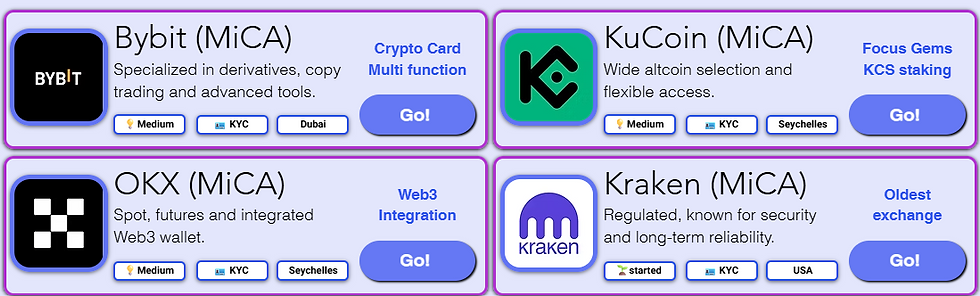
Bybit EU
Bybit's EU entity operates under MiCA authorization and offers one of the most complete trading experiences available to European users post-MiCA. The platform provides spot trading across a wide range of assets, derivatives products available to eligible users, and a competitive fee structure.
Bybit EU is particularly strong for users coming from active trading backgrounds who want a feature-complete platform that is now operating within the EU regulatory framework. The interface is clean, the liquidity is substantial, and the compliance infrastructure is in place.
KuCoin EU
KuCoin holds a MiCA license through its EU entity, though as noted in the previous article, it has faced restrictions on new client onboarding related to AML compliance matters. For existing users and new users who can access it, KuCoin EU offers a broad asset selection and a well-established trading platform.
KuCoin is worth considering for users who want access to a wider range of tokens, including earlier-stage projects that may not be listed on more conservative EU-focused platforms. Verify current onboarding status before attempting registration.
OKX EU
OKX operates its European business through an EU-authorized entity and offers a comprehensive platform covering spot, derivatives, and a built-in Web3 wallet for DeFi access. The OKX EU platform is notable for its integration of centralized and decentralized functionality: you can trade on the centralized exchange and access DeFi protocols through the same interface.
For users who want a single platform that bridges CEX and Web3 without having to manage multiple separate tools, OKX EU is worth evaluating.
Kraken
Kraken has been operating in the European market for over a decade and has a strong compliance track record across multiple EU jurisdictions. Under MiCA, Kraken holds the necessary authorizations and continues to serve EU users with a platform known for its security record, transparent fee structure, and institutional-grade reliability.
Kraken is particularly suitable for users who prioritize a proven security track record and regulatory transparency over a wider asset selection or more advanced trading features. It is one of the most conservative and well-regarded options in the EU market.
Which One Should You Choose?
The honest answer is that the best choice depends on what you actually need from a centralized exchange.
For active trading with wide asset access: Bybit EU or OKX EU. For a broader altcoin selection: KuCoin EU where available. For maximum reliability and security track record: Kraken. For a combination of centralized trading and integrated Web3 access: OKX EU.
If you are using a centralized exchange primarily for fiat onboarding and off-boarding, any of the above serves that purpose. Choose based on fee structure and which assets you need access to.
Wallets: Because Custody Means Nothing If It Is Not Yours
The Non-Negotiable Step: Move Your Assets Off Exchanges
A MiCA-compliant exchange is safer than a non-compliant one. Neither is as safe as a self-custody wallet where you hold your own private keys.
The MiCA transition is an excellent moment to establish the habit that should have been the default from the beginning: keep on exchanges only what you need for active trading. Hold everything else in a wallet you control.
CryptoDroply's Wallet section → covers the full range of options evaluated for security, compatibility, and user experience. The two fundamental categories:
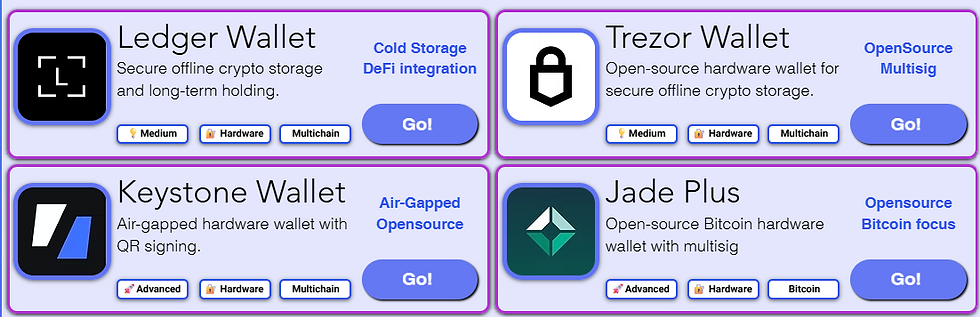
Cold wallets are hardware devices that store your private keys offline, completely isolated from the internet. They sign transactions internally without the private key ever touching a networked device. For significant holdings that you are not actively trading, a cold wallet is the appropriate custody solution. The leading options, evaluated in detail in the Wallet section, represent the highest security standard available to individual holders.
Hot wallets are software wallets, either browser extensions or mobile applications, that remain connected to the internet and are designed for active use: DeFi interaction, airdrop farming, DEX trading, and regular onchain activity. They offer convenience at the cost of a higher attack surface than cold wallets. The standard approach for serious users is a cold wallet for long-term storage and a hot wallet for operational funds.

The Wallet section on CryptoDroply covers vetted options across both categories, with guidance on which wallet is appropriate for which networks and use cases.
Whatever wallet you choose, the fundamental rule applies: write down your seed phrase on paper, store it in multiple secure physical locations, and never share it with anyone under any circumstances.
Decentralized Exchanges: Operating Without Asking Permission
For Users Who Want to Stay Onchain
The MiCA compliance question applies to centralized service providers. It does not apply to decentralized protocols that have no EU legal entity and operate purely through smart contracts on public blockchains.
DEX interaction through your own wallet keeps you in custody of your assets at every step, eliminates the platform compliance question, and gives you access to the full range of onchain trading and liquidity management. The tradeoff is that you bear full responsibility for your security practices and for verifying the contracts you interact with.
Three DEX tools worth having in your setup:
Hyperliquid
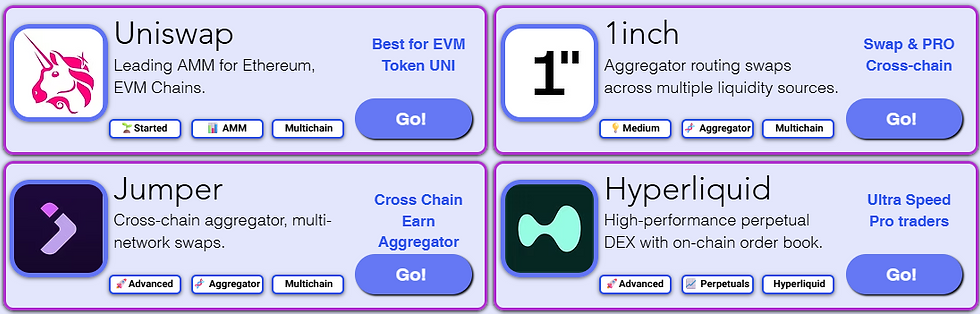
Hyperliquid is a decentralized perpetuals and spot trading platform that offers an experience closer to a centralized exchange order book than most DeFi trading interfaces. It runs on its own L1 blockchain optimized for trading, with on-chain settlement and genuinely deep liquidity.
For users who want leverage trading without a centralized custodian, Hyperliquid is the most developed decentralized alternative currently available. It offers both spot trading and perpetual contracts with up to significant leverage, with all positions settled on-chain and all funds in self-custody until a position is opened.
1inch
1inch is a DEX aggregator that routes your swap across multiple decentralized exchanges to find the best available price and lowest slippage. Instead of manually checking Uniswap, Curve, Balancer, and other protocols separately, 1inch does the routing automatically.
It also supports limit orders on DEX liquidity: you can set a target buy or sell price and the protocol executes when the market reaches it, without you needing to be present. For users transitioning from CEX order books to DeFi, this is one of the most practically useful DEX tools available.
Jumper.xyz
Jumper is a cross-chain bridge and swap aggregator that finds the best route for moving assets between different blockchains. Moving from Ethereum to Arbitrum, from Solana to Base, or across any combination of supported networks is handled through a single interface that compares bridge fees, speed, and security across multiple bridging protocols.
For users active across multiple chains, which is almost everyone doing serious airdrop farming or DeFi work, Jumper significantly reduces the friction of cross-chain operations and the research needed to identify the optimal bridging route manually.
Privacy: The Part Nobody in the Compliance Conversation Wants to Mention
MiCA Is a Control Framework as Much as a Protection Framework
Here is the conclusion that the compliance conversation almost never reaches.
MiCA protects EU users from unregulated platforms. That is a genuine benefit. It also creates, for the first time, a fully documented, legally mandated infrastructure for monitoring every significant crypto transaction made by EU residents through authorized service providers.
Every MiCA-licensed exchange is required to maintain KYC records, monitor transactions for AML purposes, report to financial intelligence units, and retain data for extended periods. The authorization that makes these platforms safe to use is also the authorization that makes them compliant surveillance nodes within the EU financial system.
This is not a conspiracy. It is the stated design of the regulation and the stated requirement for authorization. The EU's financial regulatory framework requires it and it has existed in traditional finance for decades. Crypto is now being brought into the same framework.
If this concerns you, which it should if you believe financial privacy is a right rather than a privilege, the tools that address it are not on MiCA-licensed exchanges. They are in self-custody wallets, in privacy-preserving protocols, in non-KYC acquisition methods, and in the practices described in the privacy section of this platform.
Europe is attempting to bring every EU crypto user into a fully documented, fully monitored financial system. Whether that is consumer protection or financial surveillance depends on who you trust with the records and what they do with them over time.
Remember: privacy is not a crime. It is a right.
The tools to exercise it, evaluated without judgment and without referral bias, are in the CryptoDroply Privacy section.
FAQ
What happens to my funds if I stay on a non-MiCA-compliant exchange?
The outcome varies by platform but the risks include: trading restrictions, withdrawal delays, access blocks, and in the worst case, funds frozen during regulatory enforcement proceedings. You have no control over the timeline. The only protection is to move your funds before enforcement action begins.
Are DEXes affected by MiCA?
MiCA regulates centralized service providers with EU legal entities. Truly decentralized protocols that operate through smart contracts without a controlling EU entity are not directly regulated by MiCA. Using a DEX through your own wallet does not require MiCA authorization from any party.
Should I move all my crypto to a wallet and stop using exchanges?
Keep on exchanges only what you need for active trading or fiat conversion. Everything else belongs in a self-custody wallet where you hold the keys. This was good practice before MiCA and remains good practice after it. MiCA makes the distinction between custodial and self-custody holdings more operationally significant, not less.
Is USDC safe to use as a USDT replacement in the EU?
USDC is MiCA compliant, issued by Circle which holds the relevant EU authorizations. It is the most practical like-for-like alternative to USDT for EU users on licensed exchanges. As with any stablecoin, it carries the counterparty risk of the issuer rather than being a risk-free asset.
What is Hyperliquid and how is it different from a centralized derivatives exchange? Hyperliquid is a decentralized trading platform for spot and perpetual contracts. Unlike centralized exchanges, it has no custodian: your funds remain in your control until you open a position. Settlement is onchain. The experience is closer to a centralized order book than most DeFi trading interfaces, making it a practical alternative for users who want leverage trading without centralized custody.
The MiCA transition is not something to watch from a distance. It is happening now, to your exchange accounts, to your USDT holdings, and to the platforms you may have been using without questioning their regulatory status.
The path forward is straightforward: move to authorized exchanges for what requires a centralized platform, move everything else to self-custody, and use decentralized tools for the activity that does not require a CEX at all.
The compliance layer protects you from the worst outcomes of unregulated platforms. The self-custody layer protects you from the worst outcomes of regulated ones.
And the privacy layer, which MiCA does not address and which the compliance conversation almost never reaches, is your own business.
Europe is building control infrastructure for crypto users. That is what MiCA is, alongside its consumer protections.
If you care about your financial privacy, use the tools that preserve it. They are in the Privacy section of CryptoDroply. And remember: privacy is not a crime. It is a right.


