
Centralized vs Decentralized Exchanges: What Really Differs
3 October 2026
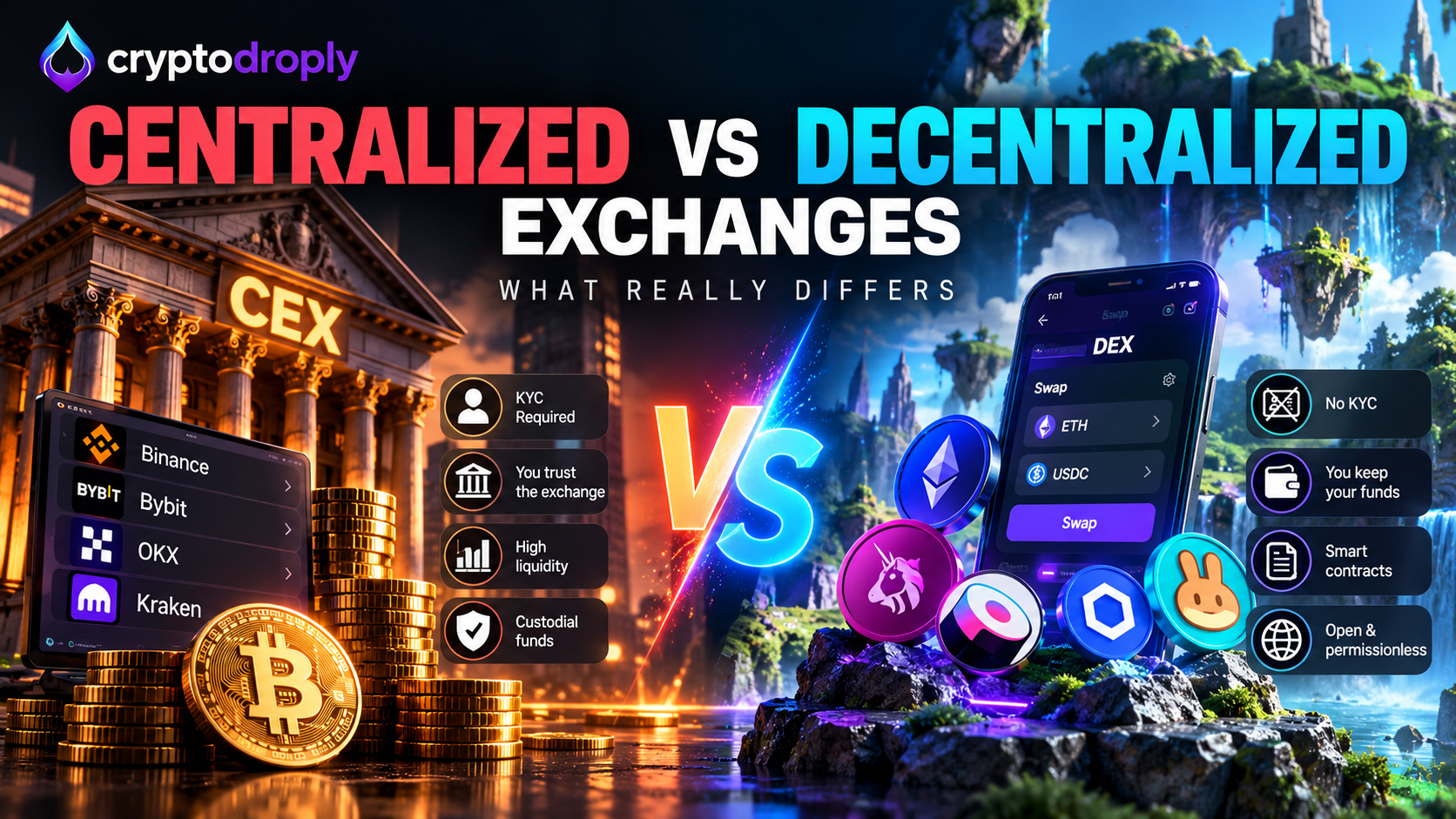
Every crypto trade happens somewhere. Most beginners start on an exchange run by a company. Others trade straight from a wallet on a decentralized platform. The two models work very differently, and each has its own risks.
This guide explains the difference between a CEX and a DEX in plain terms.
What is a CEX?
A centralized exchange (CEX) is run by one company. It holds your crypto and private keys for you. Coinbase and Binance are common examples.
When you open an account, you usually deposit funds into a wallet the exchange controls. The exchange takes custody of your assets and handles the trading. This is called a custodial setup.
Think of it like a bank. It is convenient because you do not manage private keys, but you trust someone else to keep your assets secure.
CEXs are usually easier for beginners. They let you buy crypto with fiat currency and offer customer support.
What is a DEX?
A decentralized exchange (DEX) has no company holding your funds. You keep control of your crypto and trade directly from your wallet using smart contracts. Uniswap is a well-known example.
Many DEXs use an automated market maker (AMM). An AMM is a smart contract that holds reserves of tokens. Users trade against these reserves at prices set by a formula.
This is different from a normal order book. Order books rely on buyers and sellers posting competing offers, and trades happen only when prices match. An AMM prices trades with code instead.
AMMs need liquidity providers. These users supply assets to the pool and receive LP tokens that represent their share. Fees are paid to liquidity providers and blockchain networks.
Key differences at a glance
Custody. This is the biggest difference. On a CEX the exchange has ultimate control of the crypto. On a DEX the user does. You may know the phrase "not your keys, not your coins". It describes this exact point.
Token choice. CEXs curate the coins they list and usually vet them first. DEXs have an open design. Nearly any token can be listed without permission if it meets the technical requirements. That openness is useful, but it also means more low-quality tokens.
Ease of use. CEXs are simpler. DEXs let you keep your keys, but their interfaces can be harder to use.
Liquidity. One comparison table rates CEX liquidity as high and DEX liquidity as variable. Liquidity affects how easily you can trade without moving the price.
Fiat access. One 2025 overview says CEXs continue to dominate derivatives and fiat access, while DEX adoption is rising.
Risks on each side
Neither model is risk free.
On a CEX, the main risk is counterparty risk. Users must trust the exchange to safeguard their assets and manage their keys securely. Cybercrime, bankruptcy or legal action can affect user balances. An account can also be frozen even after you passed KYC. Some platforms add protections. Examples are two-factor authentication and cold storage.
On a DEX, the risks move to you and to the code. DEXs carry smart contract, front-running and general usability risks. You must take personal responsibility for security. If you lose your seed phrase or approve a bad transaction, no support team can undo it.
Providing liquidity adds its own risk. The point that you are safe from exchange hacks applies if you are not a liquidity provider.
Rules and compliance
The legal side also differs. In the EU, MiCA is the main crypto law. It applies to crypto-asset service providers, which include exchanges and trading platforms. That is why CEXs must be authorized and supervised.
DEXs are less clear. MiCA does not apply where services are provided in a fully decentralized manner without any intermediary. But the law gives no precise test for that label. In practice, frontends and DAOs with identifiable issuers can fall within scope.
So a DEX is not automatically outside the rules. Taxes also apply in many countries whichever type you use. Check the rules where you live.
What to do
- Decide what you need. If you want to buy with fiat and have support, a regulated CEX is the simpler start. If you want self-custody and access to more tokens, learn how a DEX works first.
- Check the platform. For a CEX, look at its licenses in your country and its security features. For a DEX, use the official website and check the link twice.
- Turn on strong security. Use two-factor authentication on exchange accounts. Use a hardware wallet for larger amounts if you self-custody.
- Protect your seed phrase. Never share it. Never type it into a website.
- Start small. Test with a small trade before you move larger amounts. Check the network and the token address.
- Do not keep everything in one place. Spreading funds reduces concentration risk. Do not leave on an exchange more than you are willing to have stuck.
- Keep records. Save your trade history so you can meet your tax duties.
- Follow local laws. Complete identity checks where they are required and report taxes as your country asks.
Sources
- Centralized vs. Decentralized Crypto Exchanges, CoinLedger
- Centralized vs. Decentralized Exchanges, Britannica
- Centralized Vs Decentralized Crypto Exchanges, Coin Bureau
- Centralized vs Decentralized Exchanges, CoinMarketCap Academy
- Decentralized vs Centralized Exchanges: A Complete Guide, Komodo
- Tax Policy Handbook for Crypto Assets, arXiv
- Centralized vs Decentralized Exchanges, Analytics Insight
- Uniswap V2 Architecture, RareSkills
- Glossary, Uniswap Docs
- What is an Automated Market Maker?, Uniswap Blog
- MiCA Regulation Explained, Cyfrin
- Is DeFi Truly Exempt from MiCA Regulations?, Merkle Science
- MiCA Explained: EU's Crypto Regulation, Eco
This article is for information only and is not financial advice.